
Venus, the star of Inanna
Her sky
The app shows where Venus really is in your sky. This is what you are looking at, and how sure each line is.
The Morning Star and the Evening Star
Venus is the brightest light in the night sky after the moon. She is a world a little smaller than Earth, wrapped in white cloud that shines back the sun.
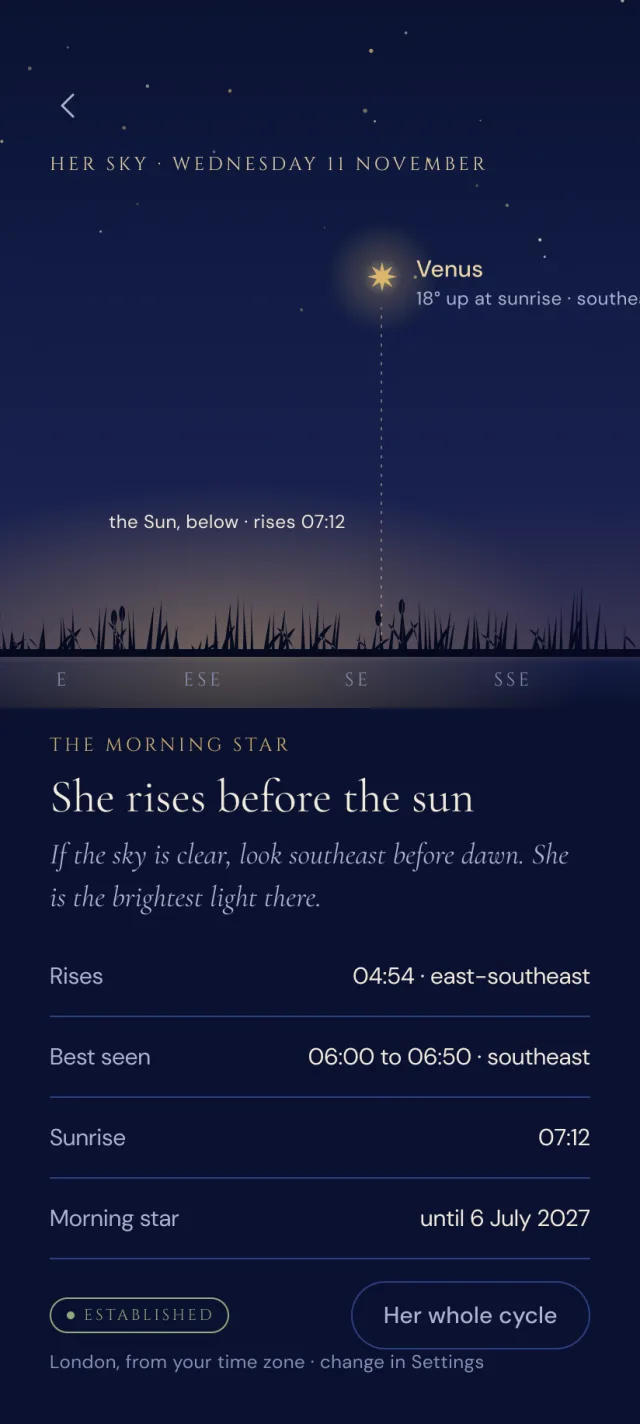
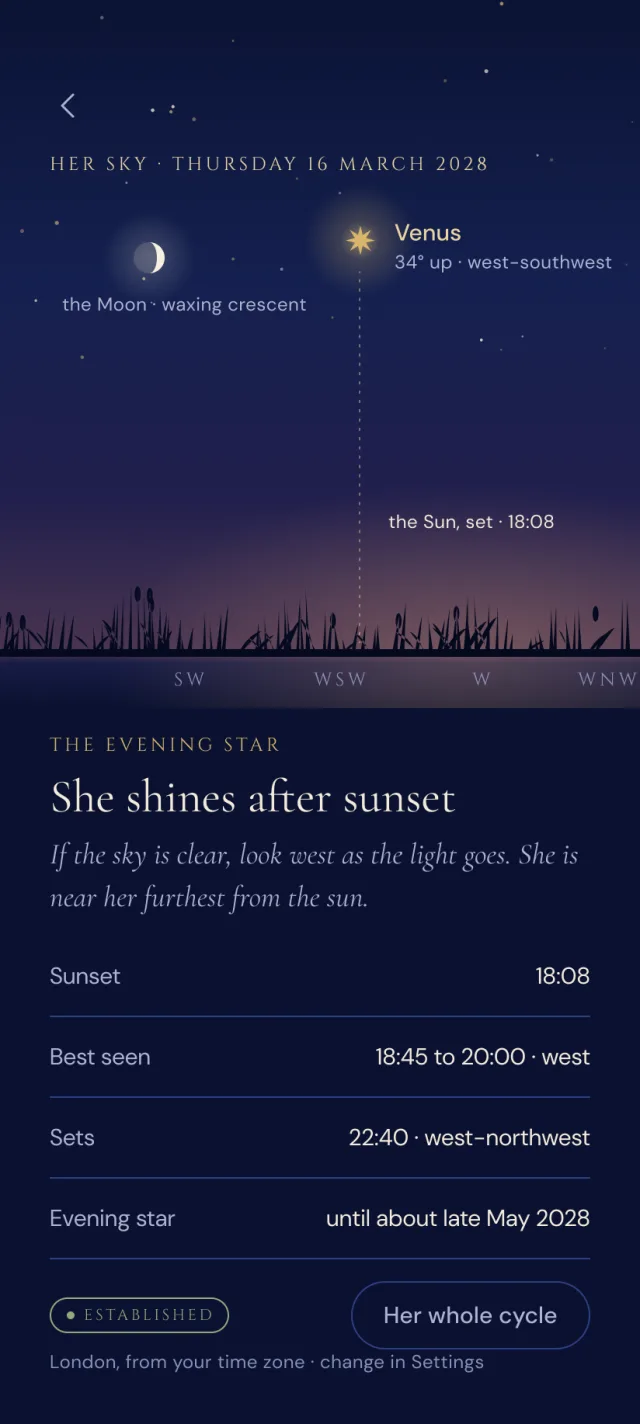
Her orbit lies inside ours, so from Earth she never strays more than about 47° from the sun. She is always either rising before the sun in the east, the Morning Star, or setting after it in the west, the Evening Star. She is never high at midnight.
Her round
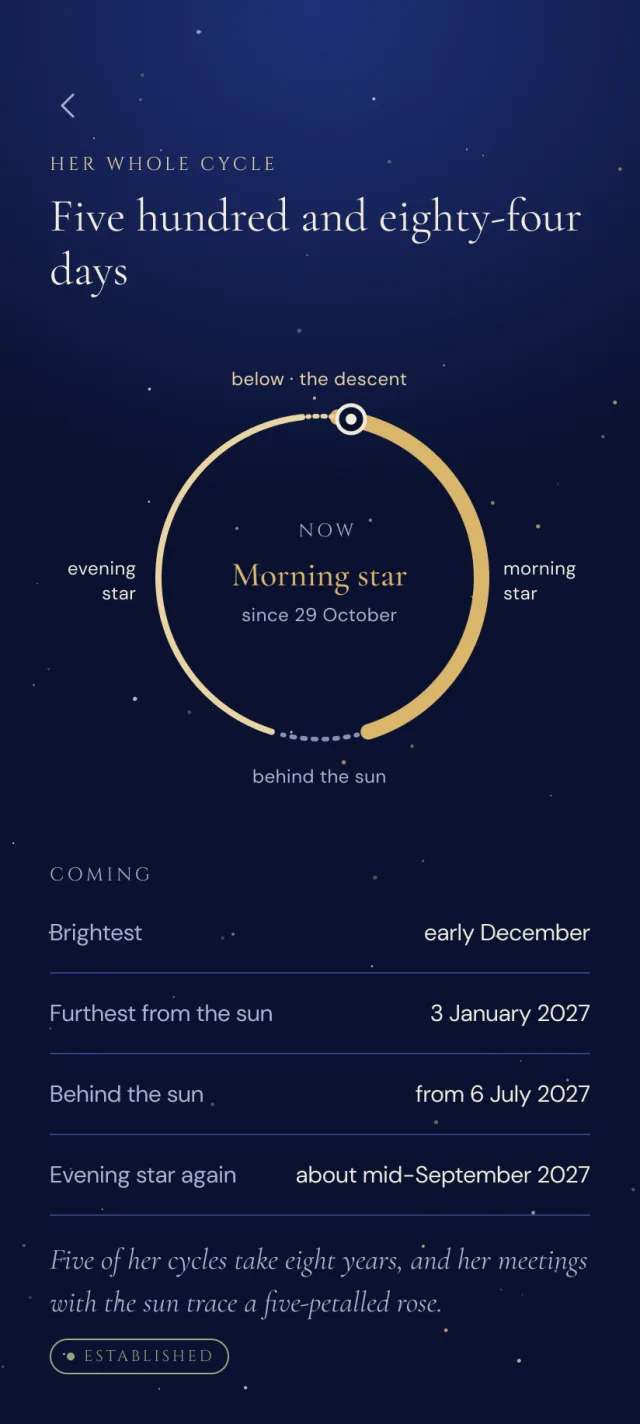
Her round takes about 584 days. She is the Evening Star for about eight and a half months, then passes between Earth and the sun and is lost in its glare for a week or two. She is the Morning Star for about eight and a half months, then passes behind the sun and is lost for about two months. Then she is the Evening Star again.
Five rounds, eight years
Five of her rounds take eight years, to within about two days. Her five meetings with the sun fall at five places around the sky, and joined in turn they make a five-pointed star. Seen from Earth, her path over those eight years draws a five-petalled rose.
The eight points of Inanna’s star may echo the eight years of Venus’s rhythm. No ancient text says so.
Her descent
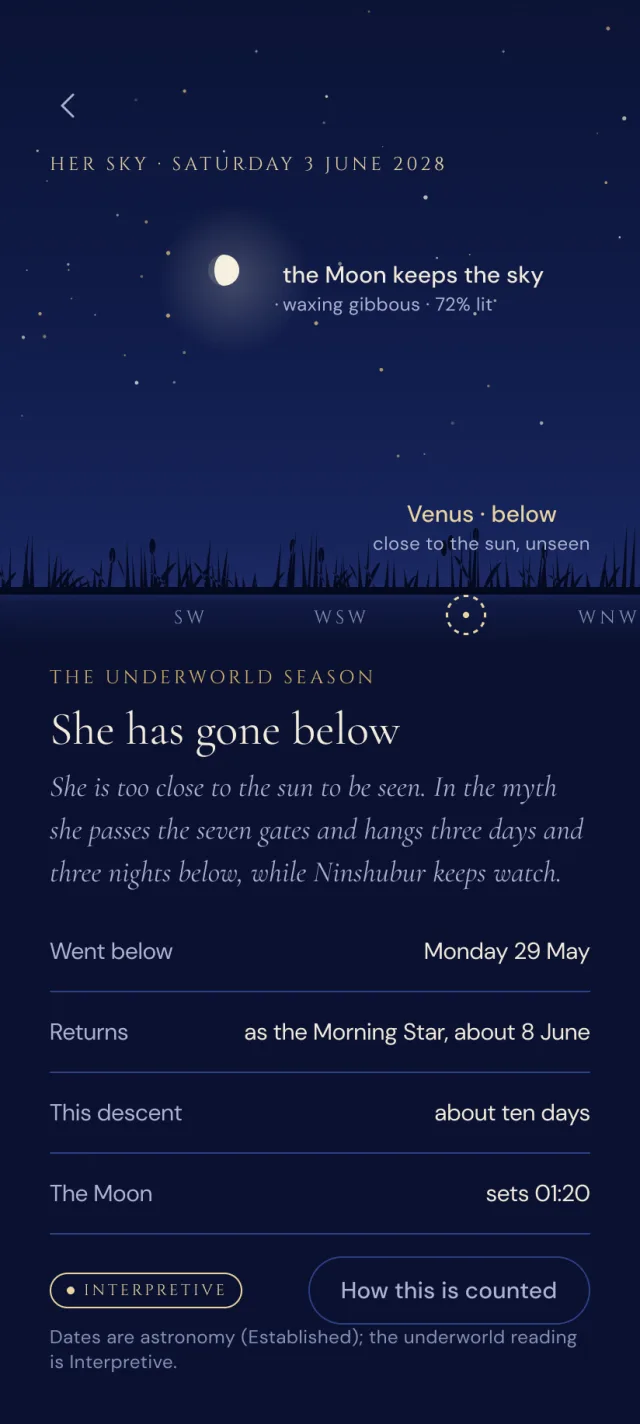
Inanna went down to the underworld, the realm of her sister Ereshkigal, and passed through seven gates. At each she gave up part of her regalia, until she came before her sister with nothing.
The short gap is read as the descent: she sets in the west as the Evening Star and rises in the east as the Morning Star, lost and then reborn, which is the shape of the myth. Writers do not agree which gap the myth belongs to; this is our reading.
The underworld season’s seven gate nights are the seven evenings before she passes between Earth and the sun, then three nights below, then her return on the first morning she is out of the glow.
Venus’s rhythm of shining, vanishing and returning is the oldest sky pattern tied to Inanna, and many readers see in it the shape of her descent.
How sure is each line?
Every statement about her history and her sky carries a label, so that history and devotion are never confused. Nothing here is secret, and nothing needs to be believed.
- Established
What the ancient texts say, or what scholars broadly agree on.
- Interpretive
A reading of what those texts mean. Others may read them differently.
- Speculative
A link this practice makes for itself. It is offered, not proven.
- Visionary
Modern devotional experience. It speaks from practice, not from history.
Sources
Venus’s motions follow standard astronomy; the app works them out on your phone. The descent follows The Descent of Inanna, in Diane Wolkstein and Samuel Noah Kramer, Inanna, Queen of Heaven and Earth (1983).